

For many international students, the Graduate Visa is the first step into their UK career — but it is not the final goal. Most graduates eventually want long-term stability, a pathway to settlement (ILR), and a visa that reflects their professional skills.
The Skilled Worker Visa provides all of that.
But switching from the Graduate Visa to the Skilled Worker Visa is not always simple. Salary rules have increased, employers are often confused about sponsorship, and timing matters more than students may realise.
This guide explains exactly how to switch safely from the Graduate Visa to the Skilled Worker Visa — without risking a refusal or a gap in your right to work.
Let’s begin.

1. Understanding the Graduate → Skilled Worker Pathway
The Graduate Visa gives you:
- 2 years with permission to work in the UK (3 years for PhD holders)
- No restrictions on job type
- Flexibility to change roles easily
- Time to build UK experience
- A chance to prove yourself to employers
But:
❌ Graduate Visa cannot be extended
❌ Graduate Visa does not allow for dependants
❌ Graduate Visa years do NOT count towards ILR
✔ Skilled Worker Visa CAN be extended
✔ Skilled Worker Visa allows for dependants
✔ After 5 years* in the UK on a Skilled Worker Visa you can apply for ILR
* This is likely to change to 10 years starting April 2026.
If your long-term goal is settlement or citizenship, switching sooner is better —but only if your job meets the Skilled Worker rules.
2. Are you eligible to Switch?
To switch from Graduate Visa to Skilled Worker, you must have:
✔ A qualifying job offer
✔ An employer with a Skilled Worker Sponsor Licence
✔ A salary that meets the Skilled Worker minimum
✔ Be applying before your Graduate Visa expires
3. Step-by-Step Process to Switch From Graduate to Skilled Worker
Here is your full switching roadmap:
Step 1 — Confirm Your Job Is Eligible
Your job must be a match for a SOC 2020 occupation code listed by UKVI in one of the following:
- Appendix Skilled Occupations [Immigration Rules - Immigration RulesAppendix Skilled Occupations - Guidance - GOV.UK]
- Appendix Immigration Salary List [Immigration Rules - Immigration RulesAppendix Immigration Salary List - Guidance - GOV.UK]
- Temporary Shortage List in Appendix Skilled Worker SW 6.1A [Immigration Rules - Immigration RulesAppendix Skilled Worker - Guidance - GOV.UK]
Examples of eligible job types:
- Data Analyst
- Software Developer
- Engineer
- Accountant
- Policy Analyst
- Health and Care Worker
- Lab Technician (in certain SOC codes)
Examples of ineligible job types:
- Receptionist
- Administrator
- Sales Assistant
- Retail Assistant
- Customer Service Adviser
Through our associated accredited provider, advisers review Certificate of Sponsorship (CoS) details to help ensure accuracy before submission.
Step 2 — Confirm Your Employer is Licensed
Search the official UKVI register of licensed sponsors [Register of Worker and Temporary Worker licensed sponsors - GOV.UK].
If the employer is not licensed:
- They must apply for a sponsor licence (8 - 12+ weeks)
- You can continue working on your Graduate Visa while they apply
- You cannot apply for Skilled Worker until the licence is approved
Regulated adviser support (via our associated authorised provider) is available to support your employer to be licensed.
Step 3 — Confirm Your Salary Meets Skilled Worker Rules
Your salary must meet or exceed the relevant general threshold AND the going rate for your salary code if it is higher, for example:
- New Entrant at start of career minimum requirement of £33,400 + 70% going rate
- (This category will apply to most Graduates as it can be used for 2 years following graduation)
- Standard minimum requirement of £41,700 + 100% going rate
- Standard PhD minimum requirement of £37,500 + 90% going rate
- PhD in STEM minimum requirement of £33,400 + 80% going rate
- Job on Immigration Salary List minimum requirement of £33,400 + 100% going rate
See Immigration Rules - Immigration RulesAppendix Skilled Worker - Guidance - GOV.UK for the full list of thresholds.
In addition, your salary must:
- Be based on gross guaranteed pay for a maximum 48 hour week
- Match job duties
- Match work hours in your contract
If your salary is close to the threshold, consider seeking tailored assessment from a regulated adviser through our accredited provider before applying.
Step 4 — Your Employer Assigns a Certificate of Sponsorship (CoS)
This is one of the most sensitive steps.
The CoS must include:
- Correct SOC code
- Correct job title
- Correct salary
- Correct employer details
- Work address(es)
- Weekly working hours
- Accurate start date
- Accurate contract type
One error can lead to a refusal.
The job description MUST match the SOC occupation code.
Your skills, qualifications and experience MUST match the job description.
Regulated advisers can review CoS documents for accuracy before submission.
Step 5 — Apply Online for Skilled Worker Visa
You apply from inside the UK.
You will:
- Complete the Skilled Worker application form
- Upload your documents
- Pay the visa fee
- Pay the Immigration Health Surcharge (IHS)
- Book your biometrics (if needed)
- Receive your eVisa
Step 6 — Continue Working on Graduate Visa Until Decision
While your Skilled Worker application is pending:
- You can continue working under Graduate Visa conditions
- Your employment continues legally, even if your Graduate visa expires
Step 7 — Receive Your Decision
Processing times:
- Standard: up to 8 weeks
- Priority (if available): faster, but not always gauranteed
Once approved:
- You switch to Skilled Worker
- You follow Skilled Worker conditions
- Your ILR clock begins
4. Common Mistakes When Switching From Graduate Visa
These are the issues we see most frequently — and they can cause serious problems.
❌ Mistake #1: Assuming any “graduate role” is Skilled Worker–eligible
A “Graduate Marketing Assistant” or “Business Support Assistant” is not Skilled Worker–eligible if the underlying SOC code is ineligible.
❌ Mistake #2: Salary falls below going rate
Graduates often assume “salary is fine”. But going rate tables are strict. Even £1 too low which will lead to a refusal.
Make sure you check both the standard minimum and the going rate for your job – your salary must be equal to or higher than BOTH of these.
❌ Mistake #3: Employer uses wrong SOC code
This is extremely common.
Job titles like:
- Analyst
- Executive
- Coordinator
- Assistant
- Officer
Can map to vastly different SOC codes.
The Home Office will carefully check that the job description and the occupation code match.
❌ Mistake #4: CoS contains errors
Incorrect start dates, duties, or work locations are common employer mistakes.
❌ Mistake #5: Applying too late
Graduate Visa expiry dates are fixed — you cannot extend them. Some graduates wait too long and run out of time.
You MUST submit your application by the end of the day that your Graduate visa expires.
❌ Mistake #6: Relying on employer for immigration knowledge
Employers sometimes:
- Use Google instead of Appendix Skilled Worker
- Apply outdated rules
- Apply outdated rules
- Forget salary thresholds increased
This is how refusals happen.
5. Strategic Reasons to Switch Earlier
Switch earlier if:
✔ Your job already meets Skilled Worker rules
There is no benefit to delaying.
✔ You want ILR as soon as possible
Every month wasted on Graduate Visa delays ILR.
✔ Your employer is willing
Sponsorship is a good sign of commitment.
✔ You work in a high-demand role
Tech, engineering, health, finance often benefit from early switching.
6. Strategic Reasons to Delay Switching
Use Graduate Visa first if:
✔ Your salary is too low right now
You can negotiate with more UK experience.
✔ Your employer is not licensed yet
They need time to apply.
✔ Your job role will change soon
Sometimes a promotion makes Skilled Worker eligibility easier.
✔ You want to explore better roles
Graduate Visa gives you freedom to move.
Your skilled worker visa will be tied to a specific employer and role. If you wish to change employment you will need to apply for a new Skilled Worker visa.
7. Timing Your Switch Effectively
(Avoid gaps in right to work)
The optimal time to switch is usually:
- After at least 2 - 6 months of UK experience (if exploring roles)
- Once salary meets Skilled Worker thresholds
- Once the employer understands sponsorship responsibilities
Don’t wait until the final 3 months of your Graduate Visa without a plan as you are likely to run out of time.
8. What Happens to ILR Clock When You Switch?
Your ILR clock only starts on Skilled Worker.
Timing matters:
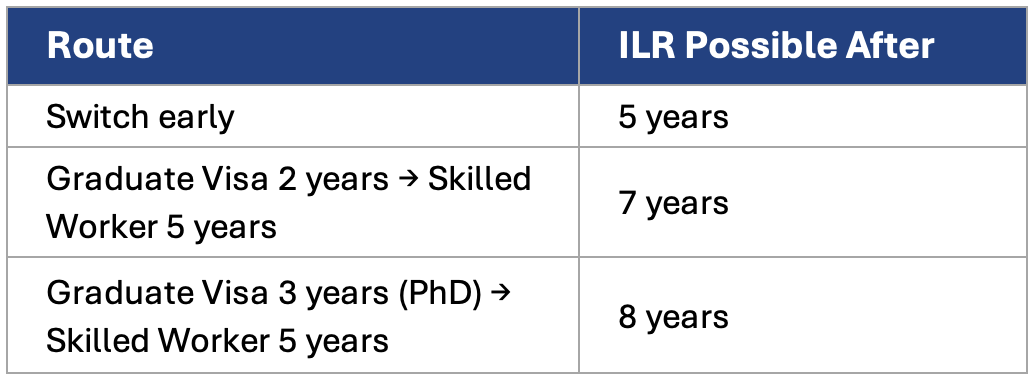
Proposed changes from 2026 may affect ILR rules, but Skilled Worker applicants currently qualify after 5 years.
9. Case Studies (Realistic Examples)
Case Study 1 — Software Developer
Graduate Visa → Skilled Worker after 5 months.
- Salary met going rate
- Employer was licensed
- SOC code matched duties
Outcome: switched early, gained 5 full years toward ILR.
Case Study 3 — Accounting Graduate
GraduateVisa → Skilled Worker after salary increased.
- Employer supported sponsorship
- Needed time to pass probation and meet salary threshold
Outcome: successful Skilled Worker application after strategy delay.
Case Study 4 — Filipino Health Graduate
Graduate Visa → Skilled Worker immediately.
- Health sector roles aligned with pay scale rules
- Employer already licensed
Outcome: switched without delay.
10. How UKVisaTeam Helps You Switch Safely
Through our associated accredited provider, regulated advisers can support you from eligibility assessment through Skilled Worker visa application steps.
✔ Eligibility check
We analyse your job role, SOC code and salary.
✔ Employer sponsorship support
We guide employers through licence applications and compliance.
✔ CoS review
We ensure all details match Skilled Worker requirements.
✔ Timeline planning
We prevent gaps in your immigration status.
✔ Full Skilled Worker application support
We prepare all sections of your application with precision.
✔ Risk assessment
We identify and fix issues early to avoid refusals.
Switching visas is stressful — but with expert guidance, the path becomes clear.
Final Thoughts
Switching from the Graduate Visa to the Skilled Worker Visa is one of the most important steps in your UK immigration journey. The decisions you make now affect:
- Your long-term UK future
- Your job stability
- Your ILR timeline
- Your financial security
- Your right to stay
You don't need to navigate this alone.
Immigration rules can change, and outcomes depend on individual circumstances. If you are unsure, consider seeking guidance from a regulated adviser.